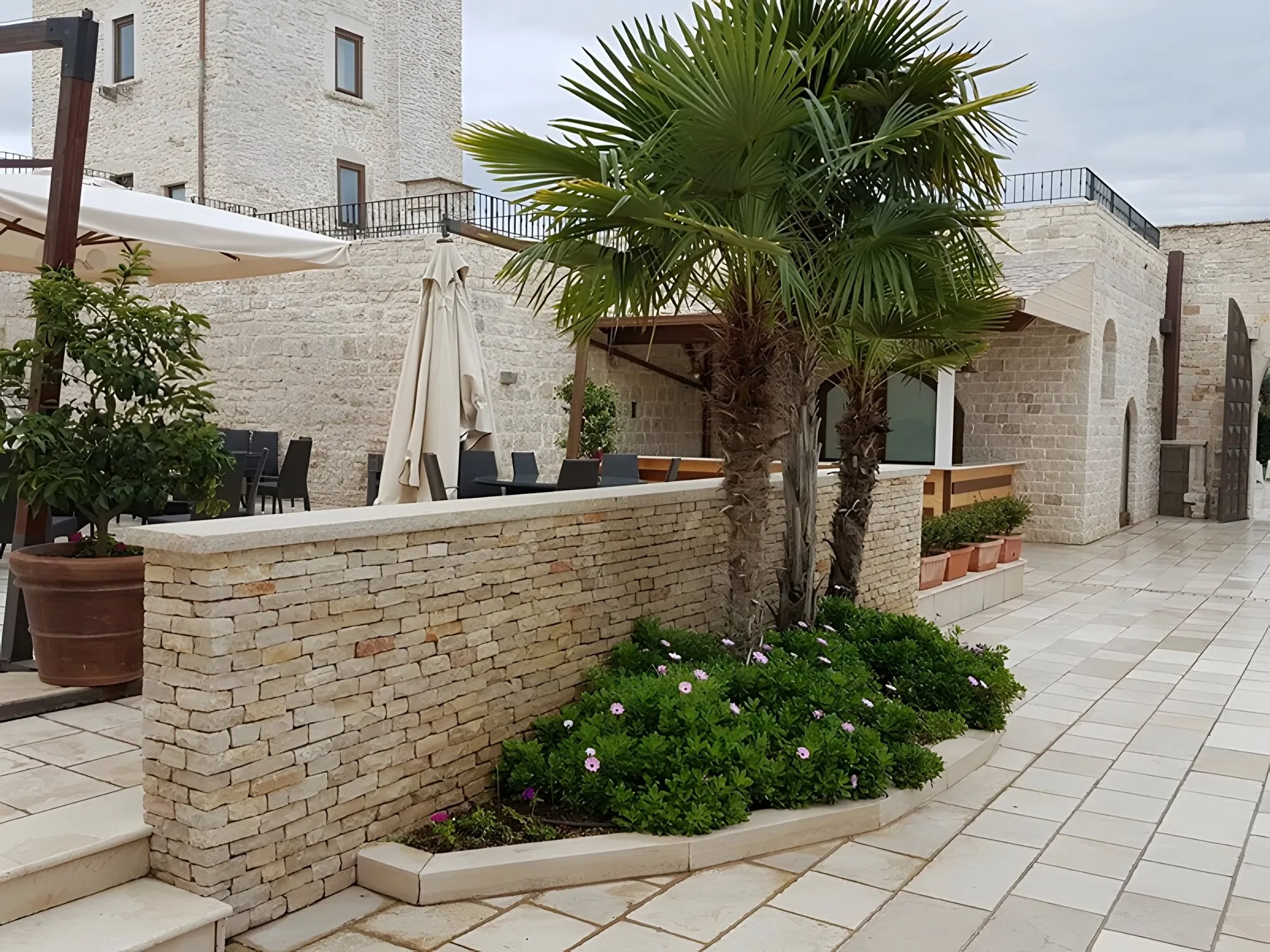
An outdoor floor or a garden wall spends years under sun, rain and, in many areas, frost. Before shape and colour, two things are worth checking: how much water the stone absorbs and how it behaves after freeze–thaw cycles.
What the data say
The technical data sheet of Trani stone gives these indicative values:
- water absorption of 0.11 % by weight and 0.32 % by volume;
- porosity coefficient 0.015 and compactness 0.985;
- compressive strength of 1,775–1,785 kg/cm² in its natural state and 1,650–1,670 kg/cm² after 20 freeze–thaw cycles;
- abrasion resistance of 2.79 mm/km.
In practice it is a compact stone that absorbs little water and keeps almost all of its compressive strength after frost cycles. That is exactly what we select for in the quarry. The full values are in the technical data.
Pedestrian and driveway paving
Outdoors, thickness matters more than finish. A few references from the catalogue:
- Crazy paving stone (opus incertum): from 2/4 cm up to 10/20 cm for pedestrian and driveway paving.
- Stone setts: 10x10 cm, 4/6, 6/8 and 10/12 cm thick, for driveway paving. One pallet weighs 18 quintals (1,800 kg) and one quintal covers about 0.8 m².
- Stone stepping paths: thick crazy paving slabs, from 6/8 to 13/16 cm, for paths and driveway surfaces.
- Split squared paving: slabs 20-25 cm wide in random lengths, from 4/6 to 8/10 cm.
- Giant crazy paving slabs: large slabs for gardens and relaxation areas, 4/6 and 7/9 cm.
The right thickness depends on the sub-base and the expected traffic: decide it with whoever designs and lays the floor. We tell you which formats are available and the coverage per pallet.
The finish changes the feel underfoot. Split and natural split faces stay rough; tumbled stone has softened edges and an antique look. The differences are explained in Trani stone finishes: split, tumbled or back-sawn?
Garden walls and copings
Split-face strips are 10 cm wide (12 cm in the 10/12 thickness) in random lengths: they are used to build garden walls, including dry-stone walls, and to clad outside walls. For an older look there are tumbled split-face strips, shipped on pallets with netting.
On top of the wall go the bush-hammered wall copings: 4 or 5 cm thick, in sizes of 15, 20, 25 and 30 cm (others on request), bevelled on two sides, with two drip grooves that keep water off the wall face.
To edge flower beds and paths there are stone kerbs, trimmed with rounded edges. Floor, wall, coping and edging can all be in the same stone.
Coast and inland
Trani stone works by the sea as well as inland: the different finishes let you choose the right surface for the place. Shape and colour stay unchanged over time and, once laid, the stone needs no periodic touching up, unlike a rendered and painted wall.
The colour ranges from straw yellow to ivory white, from beige to bronze, from red to dark yellow. Every batch is different: in our supplies we state the colour (yellow, white, red) or the mix, so floor and wall stay consistent.
Where to start
All materials for gardens, courtyards and walls are gathered on the Outdoor stone page; floors are under Stone flooring.
For a quote, write to us on WhatsApp or by email with the square metres (or the running metres of wall), the thickness you need and the delivery city: we will tell you how many pallets you need and what the transport costs.