The material
Trani stone (Trani marble)
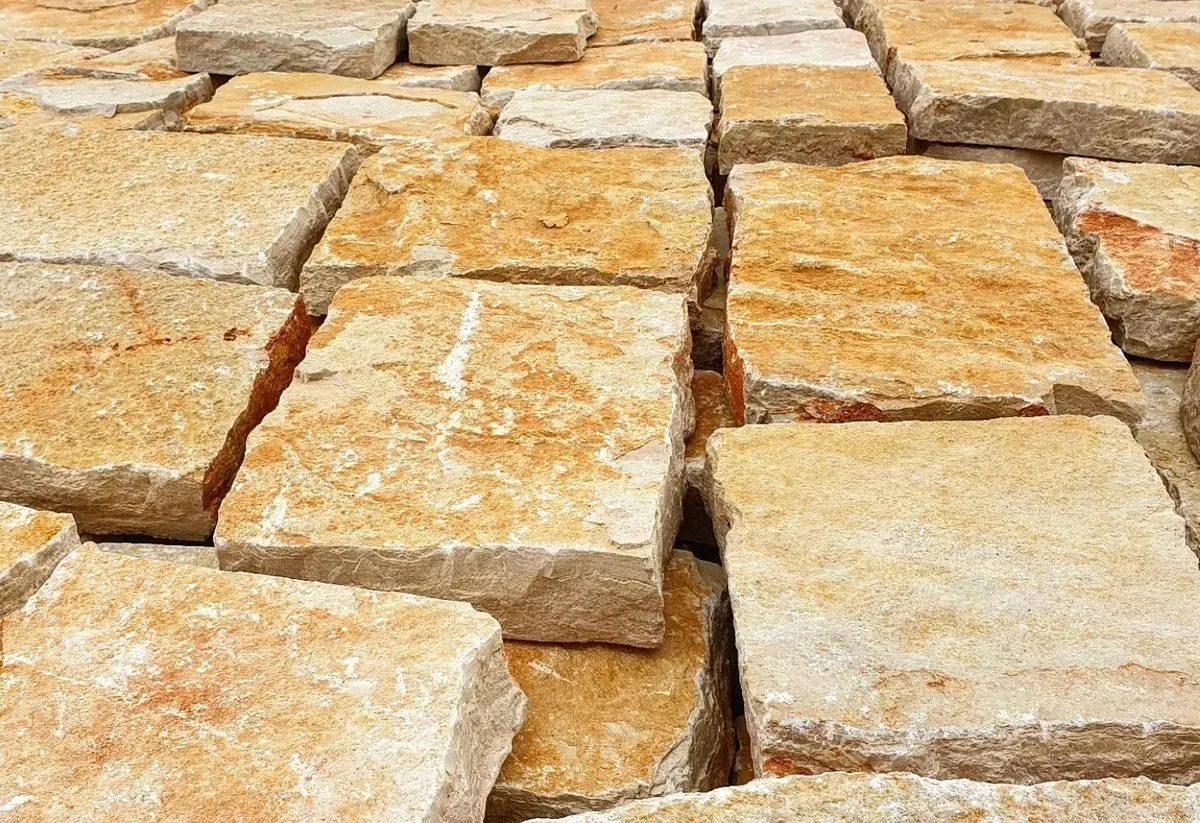
Trani stone, pietra di Trani in Italian, is a compact, fine-grained limestone quarried in Trani, Apulia, southern Italy. Frost-resistant, maintenance-free, ranging from straw yellow to ivory white.
Names and origin
The same stone is searched for under several names: Trani stone, Trani marble, and in Italian pietra di Trani or marmo di Trani. “Trani marble” is the trade name: geologically it is a compact limestone, not a marble.
It is quarried around Trani and Andria, in northern Apulia. We select and work it in Apulia and ship it on pallets.
The stone is part of the city: Trani Cathedral, known as the cathedral of Saint Nicholas the Pilgrim and standing by the sea, is built of Trani stone from the local quarries. Source: Wikipedia, Trani Cathedral
What it is
Trani stone is a limestone of detrital and biochemical origin, formed by successive layers of sediment. It is fine-grained, with a base colour of havana beige and stylolites, the thin dark lines between layers. It is easy to work: it yields slabs for flooring and cladding, tiles, machine-sawn and trimmed pieces, paving setts, edging strips and small cladding rocks. It is often sold as Trani marble, but geologically it is a compact limestone, not a marble.
Colours
Every batch is different. Trani stone ranges from straw yellow to ivory white, from beige to bronze, from red to deep yellow, so it suits both classic and contemporary spaces. In our supplies we state the colour (yellow, white, red) or the mix.
Why choose it
- It is compact and frost-resistant: that is exactly what we select for at the quarry.
- Its shape and colours stay unchanged over time.
- Once installed it needs no care or periodic touch-ups, unlike a painted wall.
- It works on the coast as well as inland, thanks to its different finishes.
Finishes
- Natural (split face)
- The face is left as it comes from the quarry: random-pattern crazy paving.
- Back-sawn
- Natural face with a sawn back: even thickness, faster wall installation.
- Split
- Machine-split with clean sides: strips, setts and outdoor paving.
- Tumbled
- Tumbled to soften edges and surface, for a time-worn look.
- Bush-hammered
- Hammered, non-slip surface for copings, paving blocks and skirting.
Technical data
| Quarry area | Trani (Apulia, Italy) |
|---|---|
| Petrographic features | Pelmicritic limestone with bioclasts (calcareous algae, ostracods, foraminifera); primary cavities filled with sparite. |
| Mineral phase | Calcite |
Chemical composition
| CaCO₃ | 98.6 % |
|---|---|
| MgCO₃ | 0.5 % |
| Fe₂O₃ | 0.2 % |
| SiO₂, Al₂O₃, Na₂O, P₂O₅, SO₃ | 0.7 % |
| Insoluble residue | 0.1 % |
Physical properties
| Specific gravity | 2.72 g/cm³ |
|---|---|
| Compactness | 0.985 |
| Porosity coefficient | 0.015 |
| Water absorption by weight | 0.11 % |
| Water absorption by volume | 0.32 % |
Mechanical properties
| Compressive strength, natural state | 1,775 – 1,785 kg/cm² |
|---|---|
| Compressive strength, water-saturated | 1,665 – 1,670 kg/cm² |
| Compressive strength, after 20 freeze–thaw cycles | 1,650 – 1,670 kg/cm² |
| Flexural strength | 185 kg/cm² |
| Elastic modulus | 380,000 kg/cm² |
| Abrasion resistance | 2.79 mm/km |
| Impact resistance | 17.5 kg/cm |
Indicative values supplied by the company. Contact us for specifications and up-to-date certificates.
Frequently asked questions
Where is Trani stone quarried?
In the quarries around Trani, in Apulia, southern Italy. We hand-select it and work it at our yard on the SP130 Andria–Trani, Contrada Muridano road.
Is Trani stone frost-resistant?
Yes. It is compact, absorbs 0.11 % water by weight and after 20 freeze–thaw cycles keeps a compressive strength of 1,650–1,670 kg/cm². That is exactly what we select for at the quarry.
What colour is Trani stone?
It ranges from straw yellow to ivory white, from beige to bronze, from red to deep yellow. Every batch is different: in our supplies we state the colour (yellow, white, red) or the mix.
Does Trani stone need maintenance?
No. Once installed it needs no care or periodic touch-ups, and its shape and colours stay unchanged over time.
Which finish should I choose?
For rustic cladding, natural split-face stone (crazy paving, opus incertum). For faster wall installation, back-sawn stone, which has an even thickness. For outdoor paving, setts and strips, split stone. For non-slip copings and paving blocks, bush-hammered stone.
How many square metres are in a pallet?
It depends on material and thickness: a pallet of Trani stone crazy paving covers 20–28 m², a pallet of split strips 11–16 m². Each material page lists its yields; tell us your square metres and we work out how many pallets you need.
Trani stone or Trani marble?
They are the same material. The trade often calls it Trani marble, but geologically Trani stone is a compact limestone, not a marble.
Do you ship outside Italy?
Yes. We ship on pallets across Italy, Europe and outside Europe. Your quote includes the cost of transport to your destination.