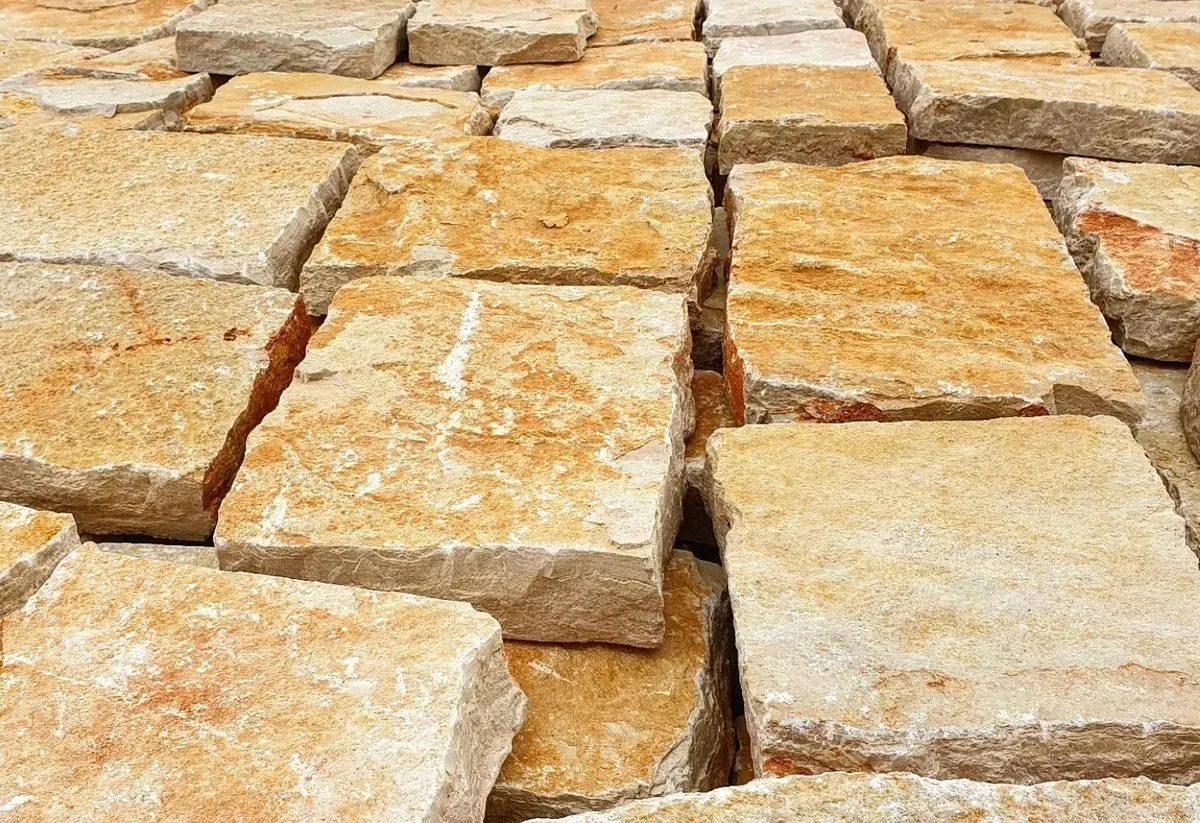
People look for this stone under many names: Trani stone, Trani marble, and in Italian pietra di Trani, marmo di Trani or marmi di Trani. There is only one material. Here is where the names come from and why, strictly speaking, it is not a marble.
Limestone or marble: the difference
In geology, marble is a metamorphic rock: it starts as limestone that, deep underground, has been transformed by heat and pressure until it recrystallises. Trani stone has not been through that process. It is a sedimentary rock, a limestone of detrital and biochemical origin formed by successive layers of deposits.
The technical data confirm it. It is a pelmicritic limestone with bioclasts, that is, fragments of calcareous algae, ostracods and foraminifera; the mineral phase is calcite and calcium carbonate (CaCO₃) reaches 98.6 %. Between the layers you can see stylolites, thin dark lines that help you recognise it.
Why it is called “marble”
In the stone trade, “marble” has long been used for compact limestones that can be sawn, honed and polished, even when they are not marble in the geological sense. It is a trade usage: that is how Trani stone also became “Trani marble”, and why many Italian workshops call everything they work “marmi”.
Neither name is wrong: one describes the rock, the other the market. For the buyer nothing changes, because the properties are those of the data sheet: compactness 0.985, water absorption of 0.11 % by weight, compressive strength of 1,650–1,670 kg/cm² after 20 freeze–thaw cycles.
Where it comes from
It is quarried in the area between Trani and Andria, in northern Apulia. We have been selecting and working it in Apulia since 2006, and we ship it on pallets across Italy and abroad.
The base colour is a light tan-beige. Every batch is different: it ranges from straw yellow to ivory white, from beige to bronze, from red to dark yellow. In our supplies we state the colour (yellow, white, red) or the mix.
Trani Cathedral
The link with the town is plain to see. Trani Cathedral, known as the cathedral of Saint Nicholas the Pilgrim and standing by the sea, is built of Trani stone from the local quarries. Work began in 1099 and it is considered one of the most significant examples of Apulian Romanesque architecture (source: Wikipedia, Trani Cathedral).
Its pale façade, a few metres from the water, has stood there for centuries: the simplest way to understand which stone we are talking about.
The same stone in every language
If you are talking to a supplier or a designer in Italy, the stone goes by pietra di Trani or marmo di Trani; in German it is Trani-Stein, in French pierre de Trani, in Spanish piedra de Trani. The same distinction applies everywhere: the name with “marble” is a trade name, the rock is a compact limestone.
Where to see it
The Trani stone page covers names, colours, finishes and the full technical data. In our catalogue Trani stone appears in almost every product, from crazy paving stone (opus incertum) to Trani marble flooring, with formats and finishes on request; the other stones (travertine, quartzite, Albanian stone) are listed under their own names.
To find the right finish for your project, read Trani stone finishes: split, tumbled or back-sawn?, or write to us on WhatsApp or by email.