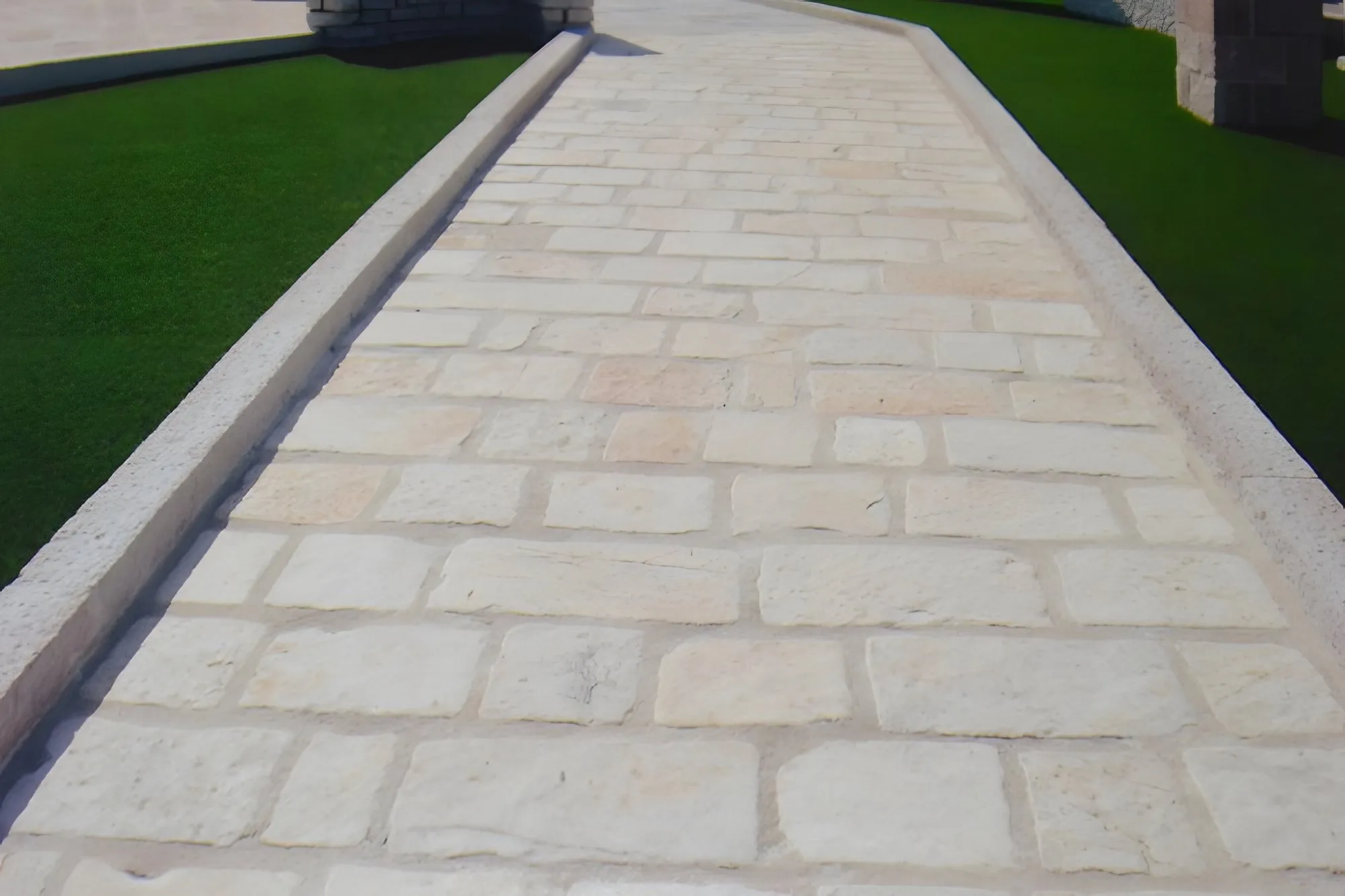
For a terrace, a porch or a garden path the most common choices are three: terracotta, stamped concrete and natural stone. They differ in origin and in result, and none of them suits everything. Here is how they compare.
Terracotta
Terracotta (cotto) is a ceramic product made from clay shaped by hand or by machine and fired in a kiln. It has warm tones, from red to orange to pink, and a rustic look closely tied to country houses. It is a porous material: outdoors it is usually treated to protect it from water and stains, and in cold areas it is wise to choose one declared frost-resistant.
Stamped concrete
Stamped concrete is made on site: a concrete slab is poured, coloured on the surface and, while still fresh, imprinted with moulds that reproduce stone, brick or wood. The result is a continuous surface, broken only by expansion joints. It goes down quickly over large areas; its look is that of the chosen mould, in other words the pattern of another material.
Natural stone
Stone is quarried, not manufactured: every piece has its own colour and veining. Trani stone is a compact limestone, with a water absorption of 0.11 % by weight and a compressive strength of 1,650–1,670 kg/cm² after 20 freeze–thaw cycles (indicative values from the technical data). Shape and colour stay unchanged over time and, once laid, it needs no periodic touching up.
If you like the look of terracotta
People who choose terracotta are often after a warm, rustic floor. In stone the same character comes from:
- tumbled stone bricks: 10x20, 10x25 and 15x30 cm, 4, 5 and 6 cm thick, for floors, edging and garden walls; one square metre weighs about 1.35 quintals (135 kg);
- tumbled squared stone: back-sawn slabs 20-25 cm wide in random lengths, with softened edges, for indoors and outdoors;
- tumbled setts 10x10 cm, for a floor with a historic feel.
Trani stone is lighter than terracotta: it ranges from straw yellow to ivory white, with red batches. If you want warmer tones, look at Brazilian quartzite in yellow and red or Albanian stone, also yellow and red.
Paths and courtyards: stone or stamped concrete
For a path, thickness comes first. In Trani stone there are:
- stone stepping paths, thick crazy paving slabs from 6/8 to 13/16 cm, for paths and outdoor driveway paving;
- giant crazy paving slabs, large slabs 4/6 and 7/9 cm thick for gardens and walkways;
- stone setts 10x10 cm for the stretches that take vehicles;
- stone kerbs, trimmed with rounded edges, to finish flower beds and borders.
Compared with a continuous surface such as stamped concrete, a stone path is made of individual pieces: if a section has to be redone, for instance to run a pipe, the pieces can be lifted and relaid. And the pattern is not stamped: it is the stone itself.
In short
- Terracotta: warm and rustic, porous, usually needs treating.
- Stamped concrete: quick over large areas, continuous, imitates another material.
- Natural stone: a real material, in many thicknesses and finishes, from driveway paths to garden walls, with copings and kerbs in the same stone.
See the materials
Formats for terraces, courtyards and gardens are on the Stone flooring and Outdoor stone pages; for frost and garden walls, read also Trani stone outdoors. For a quote, write to us on WhatsApp or by email with the square metres, the thickness and the delivery city.