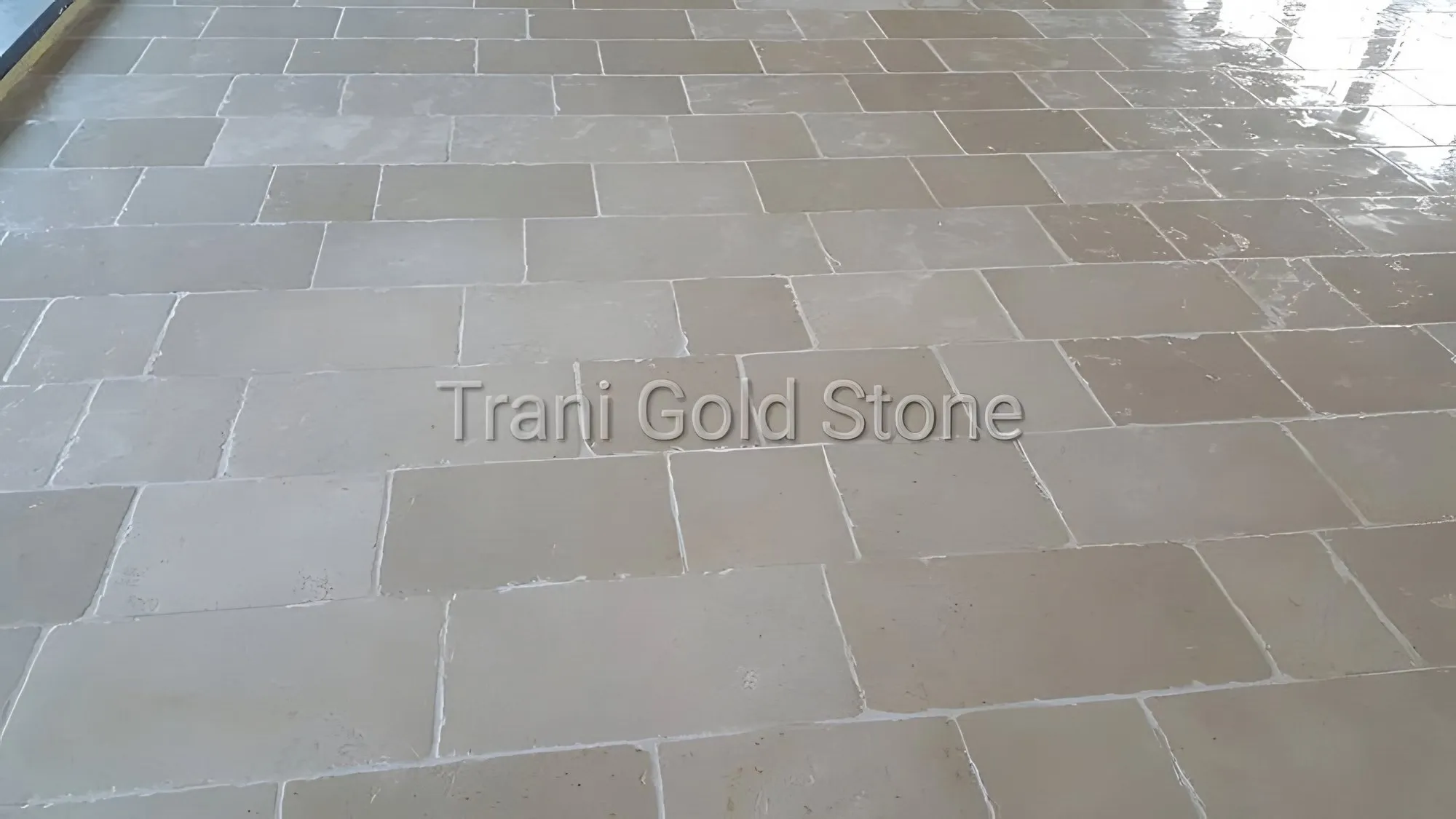
Stone-look porcelain stoneware is everywhere in tile showrooms, and at first glance some ranges look very like real stone. They are two different materials, though, each with its own strengths. Here is what sets them apart, so there are no surprises once the floor is down.
What they are
Porcelain stoneware is an industrial ceramic product: a mix of clays, feldspars and sands, pressed and fired at high temperature. The stone effect is a surface decoration, nowadays usually printed digitally from a photograph of real stone.
Natural stone is the rock itself, cut and worked. In the case of Trani stone it is a compact limestone quarried in the area between Trani and Andria, in Apulia, which we select and work ourselves.
Look
A porcelain range repeats a limited number of graphics: over a large area, a trained eye will spot the pattern. In return, batch after batch the tiles stay very similar.
In natural stone every piece is different. Colour and veining change from batch to batch and even within the same pallet: Trani stone ranges from straw yellow to ivory white, from beige to bronze, from red to dark yellow. That is why people choose it, but it needs to be taken into account: if you want a floor identical in every piece, porcelain will suit you better.
Colour through the body
In porcelain the veining sits on the surface: even in through-body coloured versions, under the decoration there is a base colour, not the stone. In stone the material is the same from one face to the other: a chipped edge or a piece cut on site shows the same stone as the surface.
Thicknesses and formats
Porcelain has calibrated thicknesses and regular formats, which simplify installation. Trani stone comes in many shapes and thicknesses:
- squared stone, back-sawn slabs 20-25 cm wide in random lengths, from 1/2 to 4/5 cm, for floors and cladding;
- tumbled squared stone, with a sawn back and softened edges, for indoors and outdoors;
- stone setts 10x10 cm and crazy paving stone (opus incertum) for driveway paving;
- for more linear floors, Trani marble flooring and flamed stone tiles, with formats on request.
Finishes
In porcelain, finishes are reproductions: textured surfaces that imitate a split or bush-hammered face. In stone, the finish is real work. Tumbled stone really does have softened edges, split stone has machine-split sides, bush-hammered stone is hammered. The differences are explained in Trani stone finishes: split, tumbled or back-sawn?
Water and frost
Porcelain stoneware absorbs very little water: it is one of its main features. Trani stone is compact too: the data sheet gives a water absorption of 0.11 % by weight and, after 20 freeze–thaw cycles, a compressive strength of 1,650–1,670 kg/cm². Both materials, chosen in the right version, are used outdoors.
Over time
Porcelain stays as it is, and that is its strength. Trani stone keeps its shape and colour over time and, once laid, needs no periodic touching up. It is a natural material, and for many people that is exactly the point: a quarried stone, not a picture of one.
Which to choose
- Stone-look porcelain: if you want uniformity, calibrated formats and a surface that does not vary from piece to piece.
- Natural stone: if you want a real material, every piece different, genuine finishes, thicknesses that can take vehicles, and the option of using the same stone for floor, garden walls, steps and thresholds.
See the floors
All formats for indoors and outdoors are on the Stone flooring page; colours and technical data on Trani stone. For a quote, write to us on WhatsApp or by email with the square metres and the delivery city.