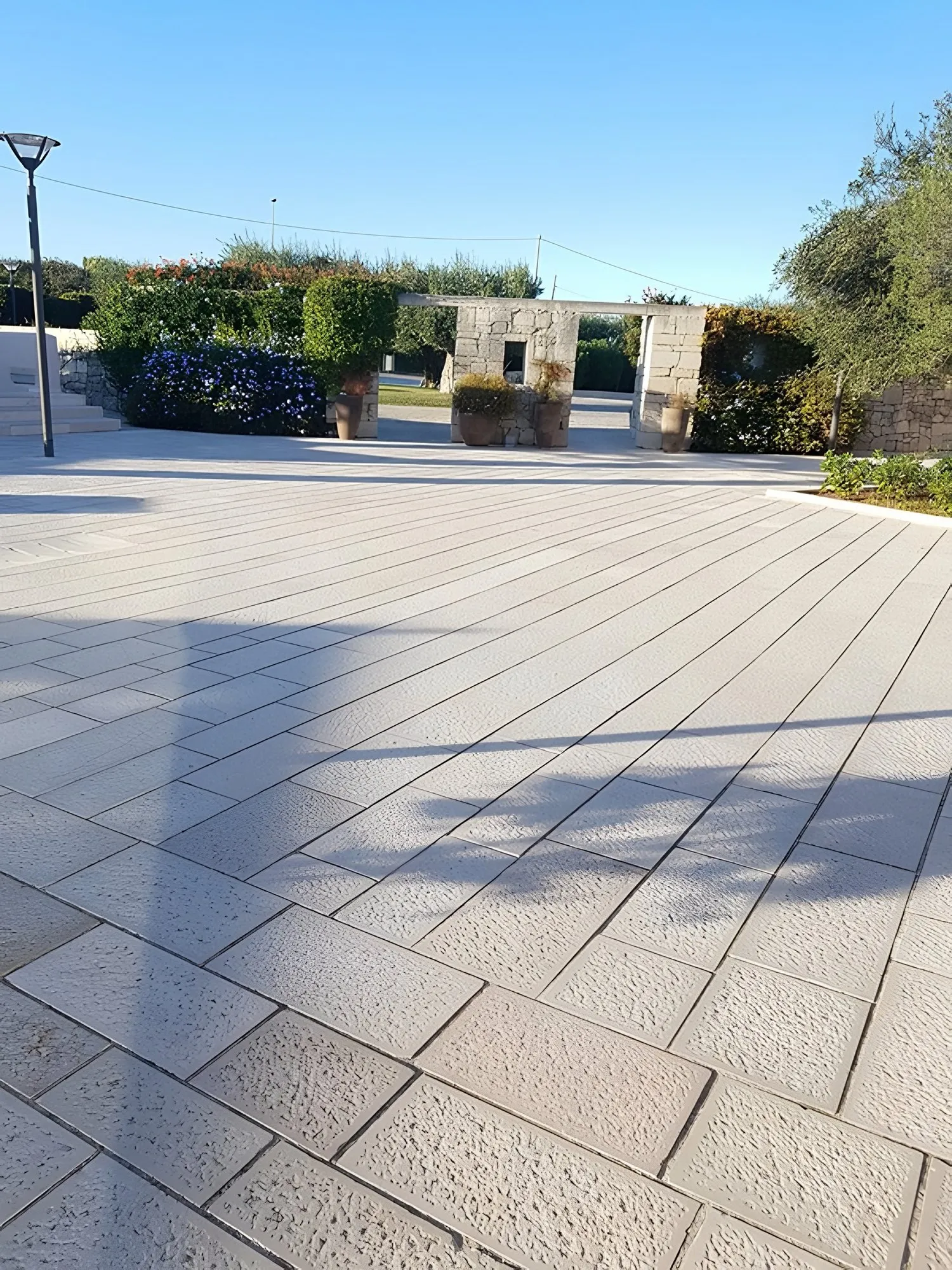
For a courtyard, a path or a forecourt the question comes up often: Trani stone or granite? We do not sell granite, so we have no reason to run it down: it is a sound and widely used stone. Here is what sets the two materials apart, so you can choose on the basis of the project rather than the name.
Two rocks of different origin
Granite is an intrusive igneous rock: it forms as magma cools slowly deep underground and is made up mainly of quartz, feldspar and mica crystals. That gives it its grainy, speckled look, in shades from grey to pink to black depending on the quarry.
Trani stone is a sedimentary rock: a compact, fine-grained limestone made almost entirely of calcite (calcium carbonate is 98.6 %). Its colour is warm and even throughout, from straw yellow to ivory white, with stylolites, thin dark lines between the layers.
Look
This is often what decides it. Granite has a grainy pattern, more or less dense; it is the material you see in many squares, pavements and road kerbs. Trani stone has a uniform surface, with the tonal variations of a sedimentary stone, and sits naturally next to pale render and the architecture of Apulia and the Mediterranean.
Hardness and workability
Granite is harder, which is one reason it is used so much in heavily trafficked public paving. Trani stone is easier to work but remains very strong: the data sheet gives a compressive strength of 1,775–1,785 kg/cm² in its natural state, a flexural strength of 185 kg/cm² and an abrasion resistance of 2.79 mm/km (indicative values).
The advantage of workability is variety. From the same material we produce crazy paving, setts, slabs in random lengths, strips for garden walls, copings and kerbs, with natural split, split, tumbled, back-sawn or bush-hammered finishes.
Frost and water
Outdoors, what matters is how much water the stone absorbs and how it copes with frost. Trani stone has a water absorption of 0.11 % by weight and after 20 freeze–thaw cycles keeps a compressive strength of 1,650–1,670 kg/cm². Granite also generally has low porosity. On this point both materials are suitable for outdoor use; for a granite, ask for the data of the specific quarry, because they vary from one type to another.
A point in granite’s favour
Like every limestone, Trani stone is made of calcium carbonate, which reacts with acids. Bear this in mind for surfaces exposed to acidic substances, and use cleaning products suitable for limestone. Granite, rich in quartz, is less sensitive.
When to choose Trani stone
- You want a warm colour, in keeping with the architecture of Apulia and the Mediterranean.
- You like a rustic or antique finish, such as crazy paving or tumbled stone.
- You want floor, walls, copings and kerbs all in the same stone.
From the catalogue, for outdoor use:
- Stone setts 10x10 cm, from 4/6 to 10/12 cm thick, for driveway paving and mosaics.
- Split squared paving: slabs 20-25 cm wide in random lengths, from 4/6 to 8/10 cm.
- Crazy paving stone (opus incertum): from 2/4 cm up for pedestrian and driveway paving.
- Wall copings and stone kerbs to finish walls and flower beds.
Next step
All materials for courtyards and gardens are on the Outdoor stone page; the full figures are in the Trani stone technical data. For a quote, write to us on WhatsApp or by email with the square metres, the thickness and the delivery city.