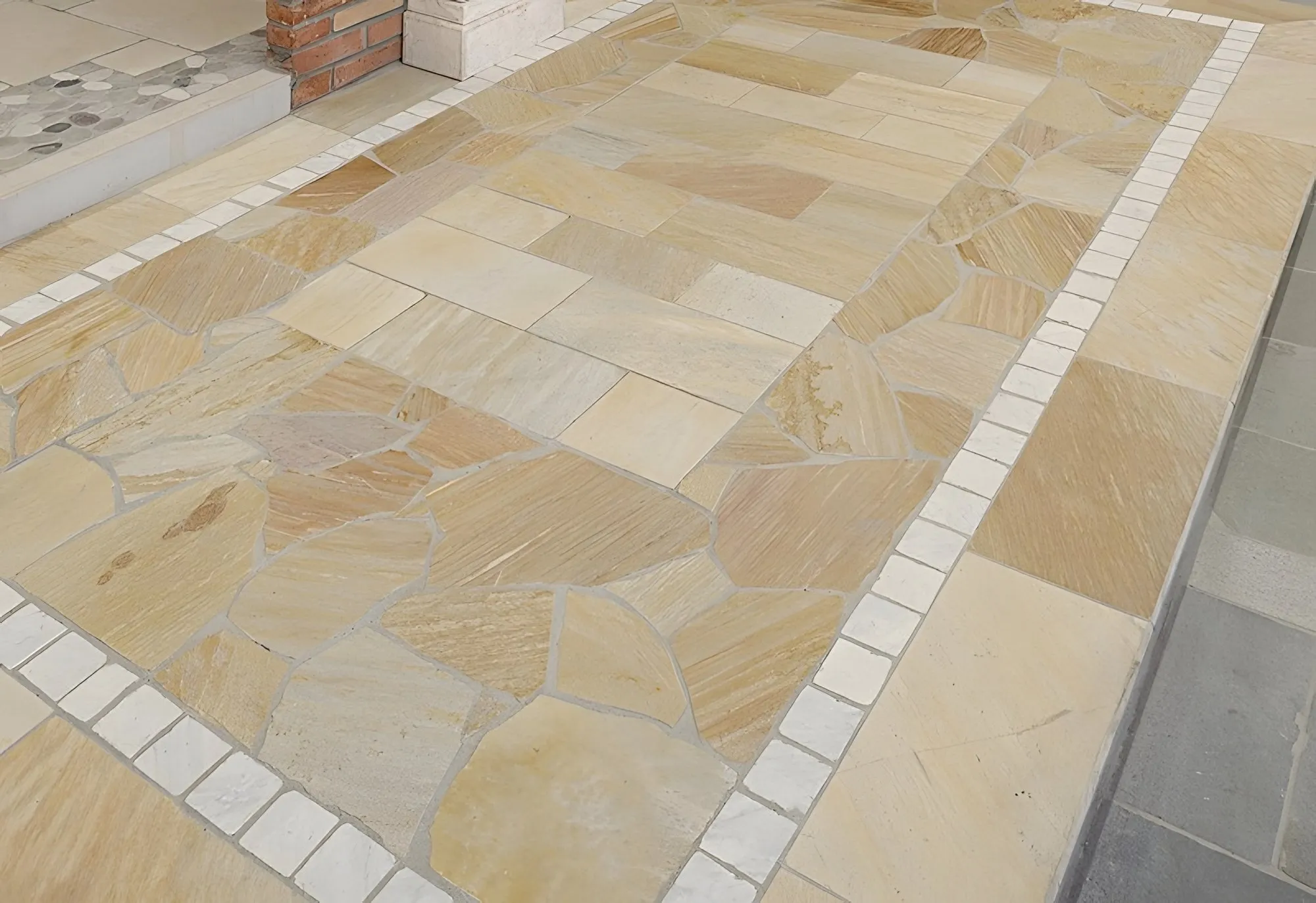
Anyone looking for a flagstone for a terrace, a path or an outside wall often thinks of slate. We do not sell it, but we are often asked for an alternative: split stone. Here is what sets the two apart and how to tell which suits you.
Slate: a rock that cleaves
Slate is a metamorphic rock formed from clays compressed and transformed over time. Its defining feature is cleavage: it splits into thin, flat sheets along parallel planes. That is why it has been used for centuries on roofs, as well as for floors, cladding and blackboards. Its typical colour is dark grey or black, sometimes with green or purple hints, and the face is usually smooth or slightly undulating.
Split stone: what we mean
“Split” means that the visible face is the natural one, created by splitting the stone, with no sawing or honing. In our catalogue the following are split:
- crazy paving stone (opus incertum) in Trani stone, in irregular pieces: 1/2 cm for wall cladding, from 2/4 cm up for pedestrian and driveway paving, in yellow, white, red or mixed;
- Brazilian quartzite, as crazy paving, in yellow and red tones, 0.8/1.5 and 1.5/2.5 cm thick, for floors and pool surrounds;
- Albanian stone, also as opus incertum crazy paving 1/2 cm thick, yellow and red;
- giant crazy paving slabs in Trani stone, large slabs for gardens and paths.
Quartzite is also a metamorphic rock, formed from quartz-rich sandstones, and like slate it opens into thin sheets: it is the split material closest to slate in form, with entirely different colours.
The differences that matter
Colour. Slate is dark. Trani stone ranges from straw yellow to ivory white, quartzite from yellow to red. In the sun, dark surfaces get hotter than light ones: worth thinking about for terraces and pool surrounds, where people walk barefoot.
Thickness. Slate splits into thin sheets. Split Trani stone goes up to 10/20 cm for driveway paving and, for wall cladding, also comes back-sawn, with a natural face and even thickness.
Surface. The split face of Trani stone and quartzite is rough and irregular; slate usually has a flatter, smoother face.
Data. For Trani stone the data sheet gives a water absorption of 0.11 % by weight and a compressive strength of 1,650–1,670 kg/cm² after 20 freeze–thaw cycles. For a slate, ask for the quarry’s data: they vary a great deal from one source to another.
Which to choose
If you want a dark, graphic effect, slate is the consistent choice and we have no equivalent to offer. If you want a split surface in warm colours, light in the sun, with thicknesses that can take vehicles, look at Trani stone or quartzite.
A few practical pointers:
- Terrace or pool surround: Brazilian quartzite or Trani crazy paving in light colours.
- Driveway path: Trani crazy paving from 4/6 cm up, or stone stepping paths, slabs from 6/8 to 13/16 cm.
- Outside wall: Trani crazy paving 1/2 cm thick or back-sawn, for a more regular installation.
With split stone every piece is different: tone and veining change from batch to batch, and that is what brings the finished surface to life.
See the materials
Outdoor floors and cladding are gathered on the Outdoor stone page; for walls there is Stone cladding. For a quote, write to us on WhatsApp or by email with the square metres, the colour you prefer and the delivery city.